

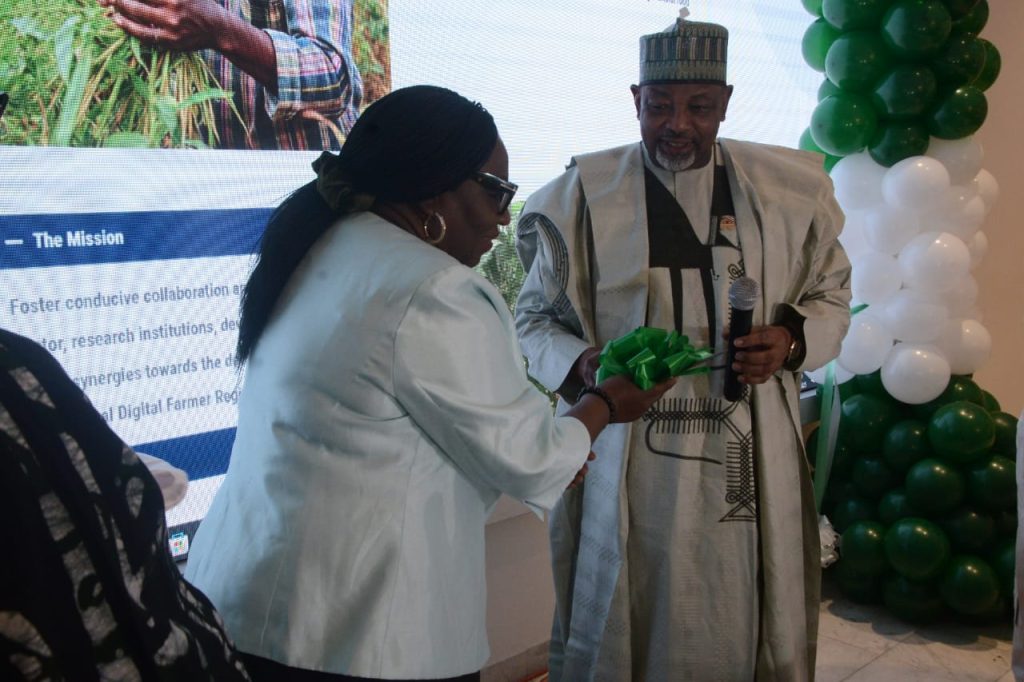
The Minister of Agriculture and Food Security, Senator Abubakar Kyari, has inaugurated the National Digital Farmers Registry (NDFR) Multi-Stakeholder Collaborative Knowledge-Sharing Platform, a major step toward harmonising Nigeria’s fragmented agricultural data system and strengthening the country’s food security architecture.
Speaking at the National Stakeholder Workshop on Best Practices for NDFR, organised by the Federal Ministry of Agriculture and Food Security (FMAFS) in partnership with the International Fund for Agricultural Development (IFAD) and Heifer International, Kyari said the initiative would deepen technical understanding of the registry, validate best practices, and enhance coordination across the agricultural ecosystem.
Kyari noted that Nigeria currently operates multiple farmer databases created through various programmes and institutions. “While these efforts offered useful insights, the absence of a unified, verifiable, and interoperable farmer database has resulted in duplication, inconsistencies, and resource leakages,” he said.
The Minister described the NDFR as a cornerstone of President Bola Ahmed Tinubu’s Renewed Hope Agenda. According to him, the President has made it clear that the era of fragmented agricultural data must give way to harmonized, digitally efficient systems.


“To strengthen agricultural planning and deliver targeted interventions, Nigeria must operate a credible and unified farmer identification system,” Kyari said. “The National Digital Farmers Registry is a critical step toward securing our nation’s food future.”
The registry will consolidate real-time, geo-referenced data on farmers Covering location, commodities, production scale, gender, and age and provide a single trusted platform for verifying beneficiaries and delivering inputs, mechanization, extension services, credit, and insurance.
Kyari emphasised that the NDFR will enhance transparency, reduce fraud, eliminate duplication, and improve Nigeria’s agricultural planning. It will also integrate with other national digital systems, enabling farmers’ access to financial services, climate-smart advisory tools, mechanization, market information, and early warning systems.
He added that the initiative aligns with the Kampala Declaration on Strengthening Digital and Data Systems for Agricultural Transformation under the CAADP framework.
In her remarks, IFAD Country Director, Mrs. Dede Ekoue, praised the Nigerian government for taking the bold step to establish a unified digital farmer registry, describing it as a transformative move for service delivery, transparency, and inclusivity.
She commended the collaboration with Heifer International and thanked government agencies, development partners, farmers’ groups, and research institutions that have contributed to the initiative since May 2025.
Heifer International Country Director, Mr. Lekan Tobe, said IFAD and Heifer are jointly supporting policy dialogue, research, capacity building, and the development of the engagement platform. He explained that the project is guided by global best practices and aims to ensure the NDFR becomes a trusted national repository.
“Imagine being able to instantly identify farmers in Kano or locate tomato producers in Katsina. This level of coordination is currently lacking, and the NDFR is designed to solve that,” Tobe said.
IFAD ICT4D Global Lead, Ms. Brenda Mulele Gunde, described the NDFR as a nationally coordinated initiative that will consolidate multiple datasets into a single, reliable source of truth.
She acknowledged potential challenges but expressed confidence that strong political backing and stakeholder alignment would ensure successful implementation.
The NDFR Policy Dialogue Initiative launched on May 28, 2025 is aligned with the National Agricultural Technology and Innovation Policy (NATIP) and the IFAD Nigeria Digital Innovation Action Plan (DIAP). It focuses on building national capacity, shaping rollout strategies, and institutionalizing multi-stakeholder engagement for a unified registry.
ALHAJI GANA MUHAMMAD
Welcome development
Mohammed Ismail
Very good development.
Tijjani Isa Mu'azu
what is benefit of Registering with the National Digital Farmers Registry
Moderator
Registering on the NDFR’s collaborative knowledge sharing platform provides significant benefits by fostering active participation in a specialized community, allowing users to contribute insights, access centralized resources and best practices, and directly engage with peers and experts to solve complex challenges.
mustaphamodu2016@gmail.com
Nation can be developed through agriculture and education. Where’s no food security no nation can move forward. Therefore, our efforts must be accounted for agriculture input and cultivation of our land to produce food.